Wednesday, June 20, 2012

The Facebook Five: Brevity

The Facebook Five hits No. 5:  Brevity

Saying it in 120 characters is one thing.  Making it memorable is another.

James Geary is the high priest of the aphorism, and today we see the most shared items on Facebook as visual mashups of the pithy quote and the cutesy photo.  Read more here on the importance of aphorism.

We even have established genres -- the Successories knock offs like Despair, the Faux greeting cards, the 19th century line drawing wood cuts, SomEEcards being the most popular form.
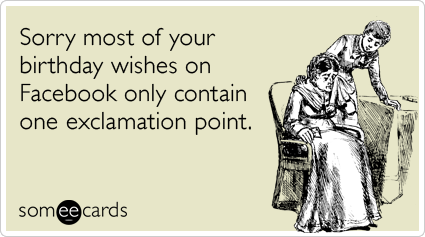


George Takei's entire Facebook feed is devoted to the concept.  And the other night, Alton Brown took it to an art form with an entire night of TwitPic Tweets (I know, mixing platforms -- but it's about the concepts, not the tools) in which he responded to the impassioned pleas of fans with photos of cartoons he drew on Post-It notes.

Pintrest's growth is based on this.  As with social trends, this is not something new in human interaction.

When you marry the right words with the timely photograph you can achieve something memorable.

They call it a post card.


What the social world ads is the "viral" -- I prefer to say networked. The folks at the old shop got this image after Arkansas advanced 2-0 in the CWS for the first time since 1979.  It brings it all together -- and happens to have the perfect line built right in as baseball coach Dave Van Horn walks under one of the branding signs at Omaha.

At the end of the process, the key to success in the Facebook EdgeRank is sharing.  If you don't say things that are interesting and provide information that people want to know, you will be doomed to the side bar, not in the main news feed.

Coming up this weekend:  The Twitter Three followed by -- if you at in St. Louis for convention -- the Four Rules of Crisis.

Alton Brown's Retro Social Genius

Freely admit this -- I am a AB cooking freak, own every book and he's taught me how to cook.

That said, tonight's exchange by Alton Brown with his fans is simply inspired.  After making a few TwitPics the past few days with Post-It notes on TV screens, he spent the entire evening interacting with his followers through a series of doodles.

At first I'm thinking he's had his Twitter feed hacked -- 30 to 40 TwitPics in a row?

After clicking on a few, he brings home an interaction like none I've seen lately.  Fans begging for specific drawings (do a hedgehog, do a hedgehog -- and he obliged).


So while it was Twitter, tell me, how Alton doesn't score a 5 of 5 on what makes for great social on the Facebook Five scale?  Even when he says goodnight.

How have you thought about leaving the box?  Something more than pictures or videos?  Please share.

Sunday, June 17, 2012

Facebook Five: Mobility

The Facebook Five hits No. 4: Mobility

There is no substitute for being there.  Period.  I read my share of "web tourist" blogs and columns.  Oh, you can watch an event "live" via streaming or interactives.

Rarely does it beat being in the moment.  I can look at all the nice National Park Service images, but nothing trumps:

This seems obvious.  You'd be surprised.

Engagement happens when you can project, when you can defeat time and space.  Humans have a particular fascination with this, and your posting from the unusual place and at the immediate time things happen feeds this.

I've lectured over and over -- if an institution is committing human resources to social media the most absurd "savings" comes in the technology deployed with them.  For years, universities resisted providing cell phones, then no iPhones, then no iPads.  Ridiculous.  You expense salary, and often travel expense, only to have a $50 a month data plan savings undermine a thousand dollar investment.

The other hindrance is the belief by staff that "it's not my job" to do social.  It is the job of the communicator on the ground to make the impact.

Thursday, June 14, 2012

I Reject Your Reality, And Substitute My Own

Adam Savage on MythBusters said that throw-away line during one of the first episodes of the series, and it stuck with me as a post-fact real-world way to explain the way executives and organizations attempt to remake a bad situation (kind of like the Reality Distortion Field).  You can even get a tee-shirt now.

It rarely ends well, but this piece of advice from the PRSA daily news out of Harvard Business Review takes Savage School to some logical, albeit scary, conclusions.

In If You Don't Like Your Future, Rewrite Your Past, Rosabeth Moss Kanter urges organizations and individuals to not let previous events limit where you can go in the future.  Parts of the blog aren't quite as bad as the headline implies -- it speaks to how IBM reshaped its future by putting different emphasis on its past.

Parts, however, are: Leaders who create the future can start by rewriting history.

Overall, it still comes off as really, really bad presentism.

Or, to restate Ms. Kanter's title, as George Orwell put it, Who controls the past controls the future: who controls the present controls the past.

Solis' Brandsphere

In light of today's earlier post, Content: King or Crap, Brian Solis provides a scathingly brilliant infographic that hammers home the point that it is all about the content and it starts with your brand story.

Stop what you are doing and baste your brain with this:  Brandsphere.

When you're done there, take a moment to backtrack through this article on Why Brands are Becoming Publishers from Mashable which led me to Solis' latest brilliance.

Wednesday, June 13, 2012

Content: King or Crap

ADDENDUM: Had I discovered this two days ago, this would have lead the blog -- Brian Solis' Brandsphere.

The battle over the future path to networked communication success often boils down to this basic battle -- is quality of content vital to ultimate success or is it just a matter serving up as much information to as many people as possible.

Daniel Tisch got this started with his PRSAY column about how public relations is losing the battle to communications.  (Sidebar guffaw: kinda how sports information lost the war with media relations, hmm fellow CoSIDA'rs).  In lamenting how consultants are moving clients away from traditional PR through focusing on communications (and one infers, strategic communication), he reminds the PRSA community of two important items:  content creation is the domain of public relations and that customer service is the new marketing (which that line smells a little like "Your New Trend of Choice is the new Black").

Tisch is a great read, but he gets down to this 140 nugget:

Solving a problem in public — in front of the entire community — does wonders for an organization’s reputation.

And that is done through well crafted content.

Doing the minimum or letting the next interface/app/gizmo/whatsit do the job in attracting and interacting with customers is yielding to technology a solution that is as relavent in today's market as Don Drapers'.  Having a message that connects is vital, regardless of the platform, and making darn sure whatever information is there is tuned for the growing mobile market.  Jason Falls weighs in here with a lengthy post-presentation story at Top Rank Online Marketing.

Why is it all important?  Remember a few weeks back when GM famously pulled out of Facebook advertising, launching the meme of advertising on the social media giant was not useful?  That's launched a back and forth about the measurement and efficacy of social advertising.

One corner of this battle is comScore and Reuters' surveys about the impact Facebook ads have, and within that, another key nugget.  Whether you think it's effective or not, what you get via Facebook and the news feed is earned media (yes, you can buy the ads and feature posts/stories).  The payoff from All Things D:

ComScore says that Facebook “earned media” ads — the kind that Facebook users distribute on their own, via “Likes” and “Shares” — do help sell stuff. In their words, the ads have a “statistically significant positive lift on people’s purchasing of a brand.

Even inside the Reuters' survey, there's a couple of supportive points:

About two out of five people polled by Reuters and Ipsos Public Affairs said they used Facebook every day. Nearly half of the Facebook users polled spent about the same amount of time on the social network as six months ago.

No one really believes all 900 million "members" are engaged.  Most experts are looking at active groups roughly a third of that number (or hey, "two out of five").  According to skeptical Reuters, what drives users away from Facebook?


Of the 34 percent spending less time on the social network, their chief reason was that the site was "boring," "not relevant" or "not useful".

Let's circle back to Jason Falls:

Brands still don’t get content. They still don’t understand that the content you deliver that appeals to and attracts an audience isn’t about your sale items or your promotions. It’s about what’s useful to the audience.

ComScore promises more info next week in a new whitepaper on the "power of like."

Think about your content for a minute.  This Facebook Five run is all about creating a specific kind of content.  Focused.  Encouraging interaction.  Getting the reader to click.

So if it's not about the quality of the content, then we could all just set up our websites to RSS into both our Facebook and Twitter feeds and maybe pick up some feeds from other generic sources and we'd have all the traffic in the world.

Grab that shotgun and see how well it hits your target.

We now return you to your regularly scheduled discussion of what makes good content for social -- The Facebook Five -- already in progress.

The Facebook Five: Visual

Part three of five breaking down the five key items to successful Facebook Five: today, Visual

Facebook is telling you what's important -- and it isn't your pithy comments or life-milestone moments.


There it is -- the legendary EdgeRank formula.  It's applied now to your news feed.  And the "W" for edge type is skewed to the visual.  If you want to delve deeper into the formula, go to Tech Crunch for a start.

They bought Instagram for a billion dollars.  Think visual is important to Zuckerburg's, well, sorry, . . . vision?

Even if the weight of the edge type was skewed for visual items, consider communication theory.  The old aphorism is correct -- a picture is worth a thousand words, and you don't have 1000 -- just 450 (and you darn shouldn't use them all) words on Facebook.  Video is universal language and if you tell a story well with images, you score a huge two-fer in this Facebook Five: the Sentiment comes naturally to great Visual. (And to hammer a point home, if you didn't click on the first two links to this paragraph to an earlier post about Who is Your Most Valuable Staff Member -- GO NOW.)

Welcome back from your past blog post interlude.  Let's refer back again to our original case study post -- the football field full of freshman.  In a staff meeting, the question was -- but what if you don't have a good picture?  Excellent point -- and of course a few minutes (let me repeat, MINUTES) to download something crisp, or better said, close up thanks to optical, not digital, zoom your message is well served.

But posting an album full of 10 great visual photos is useless if though that last factor -- time -- has eroded the being there/immediacy.  This is more important in the sports side than the general university side, but the chance to gain interaction with followers is greatest in the moment.

One of the first things I announce at CoSIDA and other talks is for people to turn their phones on.  I want them to report out and cause a buzz about what's happening.  No different at graduation.  Or at cheerleader camp when I posted a quick photo of five mascots suiting up.  There's another example of good enough image in real time.

I'm walking out of a meeting where I've said essentially what we're talking about here.  And I stumble upon these high school mascots putting on the suits.  Well, time to practice what I've just preached.  Wait for the last one to get its head on and snap the photo, post it right there, give it a pithy catch line.  Walk away.  As I'm writing this, I decide time to check the results.

Admittedly a compromised picture -- the light was bad and the exposure a bit fuzzy -- but look at what literally 60 seconds of work resulted in:  more likes than the previous six or seven links to NSU press releases combined, couple of shares, a comment or two and 14% reach -- again far better than the single digit we usually get for the push we do on news stories.

Sunday, June 10, 2012

The Facebook Five: Sentiment

Part two of five breaking down the five key items to successful Facebook strategy.

Of the Facebook Five, Sentiment seems obvious, but it is oblivious to far too many.  On a social platform, we want to share.  Many of us overshare.

When I speak of making sure there is sentiment in your post, try to discover something that connects with people, something that can evoke emotion.  It's one thing to post that photo from the event that documents it, but if you can, try to shoot from an angle or with a point of view that provides a hook for emotional connection.  If not, you need to make sure the text along with it can amplify the image and provide the connection.

Case in point today.  I fixed up an old table that belonged to my grandmother.  A friend did the sanding and some of the staining.  I did the repair -- a gap, a loose top, a broken setter board on the bottom -- and we worked to reseal it and put it back into use.

Once I finished it, I was pretty proud and decided to put the picture on my personal Facebook.  OK, old antique table.  It was my tag line that did the trick.

I was surprised how many of my friends liked on this picture -- I think I had taken much more stunning shots over the previous week of really gorgeous flowers and trees around Natchitoches -- but what gave this picture top reaction compared to the previous two weeks on my personal feed was grandma.

See, everyone loves grandma.  They love that it's grandma's heirloom.

That's the sentiment you need to discover.

The day Ray Bradbury passed away I was fortunate to have one of our former journalism teachers, Tom Whitehead, email me a scan of an envelope that Ray had sent Tom after speaking at NSU in the 1970s.  Ray drew a cartoon of an orange and purple striped tie that he was enamored with from the trip to Natchitoches on the outside of the letter.  I posted that as a bit of lagniappe for the day on our feed -- it connected NSU to a national event, it showed a personal side of Bradbury and it was unique.


Tomorrow -- The Facebook Five continues with Visual.

Friday, June 08, 2012

The Facebook Five

There is a particular strength to every social tool. As argued before, time perceived to be "saved" with a post once, appear everywhere approach works against messages tuned for the platform. Or, in a hunting analogy, you can hit a lot of stuff with a shotgun, but you'll hit the target if you aim a rifle. Here's a checklist to gauge the potential of your Facebook post.  

Immediate  
Post in the moment; nobody really likes leftovers.  

Sentiment
Everybody loves their grandma  

Visual  
Whenever possible, show, don't tell  

Mobility  
There is no substitute for being there  

Brevity  
Don't waste a friend's most valuable commodity: time

Any Facebook post needs at least one of these concepts to receive any attention. Don't believe it? When was the last time you paid any attention to a friend's Nike or Cyclemeter post that they just finished a run or a ride? Maybe the first time you noticed it, and gave them an "atta boy" like for exercising. After that, they became the antithesis of the Facebook Five: it was posted after it happened, it was soulless data, there's nothing to see, you didn't share where you went and most of all, it became an annoyance that wasted the viewer's time (and got you one step closer to being blocked).  Two words: Mafia Wars.  Need I say more?

Combine two or three, there's really opportunity for interaction. Get four or all five, you will have impact.


Here is a real example. We still post a lot of news stories on the Northwestern State Facebook page. It has more to do with a lack of population density and mobile follower logistics -- the feeds act too much like Twitter. Predictably, those posts underperform.

When I am out on campus and capture moments, we see interaction spike. Last weekend, we hosted the largest Freshman Connection session ever -- well over 500 -- and we anticipate this bodes for a record freshman class. We captured snippets of video, posted photos and encouraged them to become friends of the main NSU feed and their respective academic and social areas during meetings.

A signature event was the faux pep rally at the football stadium. All the freshman went on the field. We do it at night so the lights and video board are on. The head coach comes out and fires up the kids. With my smartphone, I capture a simple photo that shows the size of the group and the place -- and I post it immediately.

Within 28 minutes, 28 likes and the comments begin. The capture above was done at that 28 minute moment.  By morning, this photo has one of the best interactions in weeks (73 like, just over 2100 uniques; 20% reach), including comments from alumni (Oh, I remember Freshman Connection 25 years ago) and future students (I'll be there in two weeks for the next one -- can't wait). Why?

The post scored four and the comments took it to five. The photo (Visual) was snapped and posted during the event (Immediate) from the field (Mobility) with a short description (Brevity). I'd argue there wasn't a lot of Sentiment, but the alumni added that through the comments.

Over the next week or so, come back as we break down the components of the Facebook Five. Then, we'll move on to the Twitter Three and end with the Social Seven.

Monday, June 04, 2012

Sorry -- Been Busy

The thing about being a full-time employee and a part-time blogger -- well, life gets in the way. It's been an interesting past four weeks, and I appreciate everyone's support. You know who you are.

Sunday, June 03, 2012

To Tell the Truth

Funny how that still remains a "strategy", but in the face of some fairly draconian budget cuts proposed for all Louisiana public universities both major systems decided to launch an offensive of saying what those abstract numbers mean.

LSU's administrators lead off by rattling the cages that certain campus locations would be "put in mothballs." The next day, the University of Louisiana System played catch-up, issuing a template for all campuses to release.

Northwestern State was a little different among the nine peers of ULS: we put our story on the website. Only one other ULS member did so. We were the only one to link it to our Facebook and send it out via Twitter.

That was not done without some concern, and some of the reactions we got on Facebook weren't what we expected. However, the next few days, the feedback received by faculty and staff, as well as key local community members, made it well worth the "risk". They all appreciated the honesty, and became appropriately concerned (is my area on the chopping block?).

This needs to be framed for some of the national followers with this note: back in 2008, NSU made some very deep cuts in the face of another budget crisis -- dropping programs and tenured faculty. In that round, the university was pretty round beat up for not being out front with bad news.

No surprise in this space as I've always advocated that you should be the one that tells your bad news.

At the same time, you can go too far. Two Gulf Coast cities received news that they would be losing their daily newspapers, but there is a world of difference between how the Times-Picayune of New Orleans and the Mobile Press-Register shared the same info.

The Press-Register sold it with a banner headline of "Exciting News" (literally) for readers. Hey, isn't this great, you don't get a paper four days a week!

As Paul Greenburg of the Arkansas Democrat-Gazette noted, it's like saying there is exciting news, you've been laid off. (As an aside: ADG recently announced it would raise daily issue costs, which seems a little more reasonable. If you want the print edition, maybe that's going to be a boutique buy and $1 isn't unreasonable [have you checked out newsstand magazine prices lately?].

Plus, Warren Buffett -- who just bought a BUNCH of local and regional papers -- certainly didn't think the NOLA move made sense.) There is some research to back Greenburg's point: it's better to be up front with the bad news.

In Forbes a couple of weeks back, there was a very touching first-person column about how being compassionate and straight with the bad news is the best approach. If you don't believe me, ask Richard Nixon. Or Bobby Petrino.

Monday, May 21, 2012

The Most Simple Social Policy in the World

A tip of the hat to #PRSA newsletter and CBS News for the social media policy at Mayo Clinic. Talk about a high-risk environment for social -- a medical research facility of the highest profile is HIPAA central. Yet Farris Timimi boils it down to 12 words: Don’t Lie, Don’t Pry Don’t Cheat, Can’t Delete Don’t Steal, Don’t Reveal Simply brilliant. Read his detail behind the 12 words on his blog entry, but consider Another great find is Mayo's Friday Faux Pas series -- giving a whole new meaning to #FollowFriday.

Tuesday, May 15, 2012

Twitter Impact in the Political World

From Ad Week, the outside limit of response time to a Twitter outbreak: 84 minutes. Read the story to understand the reference. It is, for better or worse, the center of the political conversation, and it is transforming the way political campaigns and those who cover them do business. Toward the end, the article notes the growth of Twitter with a painfully dated number: 130 million active, up 100 million from the previous March. Although, I do like this nice geometric progression: It took Twitter three years, two months and one day to serve up 1 billion tweets; it now does that volume every three days. In the sports world. I doubt you have the 84 minute window. Take the Arkansas coaching hire announcement. Well within that time frame, team members -- not available to the general media -- were making their own comments via Twitter.

Monday, May 14, 2012

Another GoPro Use

Gear tip of the week: use your GoPro for stills that lead to stunning Facebook cover art. If you've tried to get that extreme landscape image that looks awesome -- 851 pixels wide and 315 pixels tall which translates into something along the lines of 16x6, much more "widescreen" than 16x9 -- you are missing out on the best possible tool. Aside from using an app like Pano to create nice wide images with that thin stripe down the center (check out my composite of Nam June Paik's Electronic Superhighway), the GoPro camera is a natural. I've spoken of this magic point of view camera -- they run about $250-$295 depending on the kit and now available everywhere (ie - any Best Buy) -- and this is another great reason to have it. Check out my purple flowers for the Northwestern State timeline today and my wide shot of the main gallery of NASM on my own Facebook page. If you want to see the images themselves -- NSU's flower and the X-15. See how they give you that middle edit that yields a pleasing image that fills the full width? Just frame to accommodate your profile image and there you are. Combine this with the videos and the time elapse features -- you simply MUST own a GoPro if you are serious about on-line digital. Bonus -- here's the baddest-assed plane in the USAF with the GoPro.

Sunday, May 13, 2012

There are Users, and Then There are Users

John C. Dvorak makes an interesting point on a recent DH Unplugged. While Facebook claimed 845 million users just before its IPO filing, recent info coming out as the social media giant modifies its S1 imply there may "only" be 150 million active users. Why the large discrepancy? Dormant accounts, duplicate accounts and "like farms" -- fake accounts created to only inflate views that can be purchased by the unscrupulous.

Two Halves of the Same Information Coin

Digital assets are extremely portable and once posted last forever. Wrote that in this space way back in 2006 -- what seems like an internet generation ago. Years ago a line of thinking about the oversharing at the start of networked media was in the future, no one will care because EVERYONE will have an embarrassing youth moment captured on-line. Hey kids, remember MySpace? The cassette tape to the CD that is Facebook. You bet George Zimmerman wishes that he'd been a little more diligent in deleting old social media accounts. The Miami Herald first discovered the old page, which includes a lot of personal anger toward an ex and lots of Hispanic slurs. The Washington Post. So do you just run out and delete, delete, delete? No, they'll still find you somewhere with enough diligence -- just ask Cortney Fortson who lives to this day with his tweet (SI now lists it among the 20 worst) even though he deleted it. Call it the 21st century Rosemary Woods moment. You did it, and 18 1/2 minutes of erasing won't make it go away. Or today from the Arkansas Democrat-Gazette, as the former president of Central Arkansas is called out for asking for the destruction of records that led to his ousting. How do state employees think that aggressive deletion of business correspondence syncs with the state (sometimes federal) law on preserving official records? Many justify daily deletion of all email under the guise that there is no policy or guideline in place (or the ones in place somehow don't apply to their agency or branch within an agency). As bad as it is to overshare in the social world, is it worse to violate the public trust by obfuscating your official actions by sanitizing records?

Friday, May 04, 2012

Brevity and Aphorism

In a world increasingly focused on brevity, a nice column from The Chronicle by Peter Wood on the value of being succinct.

His reference to several guidelines to being short but memorable reminds me of a great book that I highly recommend for those who need to write for executives or to have that pithy "it" in short messages.

James Geary has made a career out of dissecting what is quality in an aphorism. His blog is full of insight, but his first book, The World in a Phrase, is a must read. His listing of the great aphorisms and dissections thereof should be on every thinking writer's shelf, right next to the more traditional Roget's.

I notice today writing this post that he has a new book, I Is an Other: The Secret Life of Metaphor and How it Shapes the Way We See the World. Kindling that today.

Thursday, May 03, 2012

Happy 1400 to Me

Ah, it seems like it was just yesterday when this space began. Celebrating the 1,400th post today.

Wednesday, May 02, 2012

Good Causes, Bad Outcomes

The New York Times writes about the admirable social campaign to get people to publicize a life-giving personal fact. But in the same article, Facebook continues to press for your birth date. Why? In today's job market, it is more than vanity that moves people to not list birth dates, and especially birth years. Bad enough that some are asking for your Facebook login credentials on interviews. Timeline is crossing over from proud expressions into encouraging potentially self-damaging data. I repeat my standing Facebook line again: It is the greatest voluntary data collection and data-mining tool in the history of mankind. The Life Events are prompts to urge us into compliance with that goal and make life easy for investigators. I appreciate the feedback of colleagues @LTorbin in particular. Yes, a cancer survivor often has great pride in the victory, and those are moments to celebrate. Why one of the most courageous people I know is Yonna Pasch, who is living her breast cancer treatment very openly, very socially and it is very inspiring. And the organ donor campaign encourages that sharing of something personal for a greater good. The joke once was the foodies better fear that they would be next after the smokers were isolated as pariah and that restrictions and bans were for their own good and the greater good of society being healthier. To invert the saying, first as farce, now as tragedy: look at the growing regulations on salt, etc., from government agencies. How long until keeping your personal life private becomes a ThoughtCrime against the collective? Someday, it might be more than getting targeted ads from AARP based on your birthday.

The Final Third

The following was a response to a post on one of the message boards from back in Arkansas. I was reacting to a conversation about how the media in the area didn't "get" social media. After finishing I decided to repost here for two reasons. First, I like the rule of thirds way that the division of effective media works. Second, to show an example of how you can interact with the participatory media as someone who lives in the PR field. I'll take a slightly different angle and the rule of thirds. A third of the media remain clueless - and this is mostly management - to the way the networking of computers has changed the flow of information. They still want to be the gatekeepers, and Twitter just undercuts them. Another third understand it, but they want to just do the easiest things. They equate doing something with journalism. These are the ones who want to stream press conferences, live blog or tweet games, put up raw materials like documents and say, see, look how productive we are. The third that will survive are the ones that understand that what separates them and their craft from the second third is value added. Anyone can grab a FOIA to get Houston or Bobby's cell phone records. (An essential item the second third of media forgets - they aren't special compared to the eager citizen who could do the same thing.). You need knowledge to vet the numbers, see patterns, discover connections. That j-school training to edit, parse and separate crap from importance is the value a well trained individual adds to their work. And, with so much information out there now, the ability to sift and sort it - to curate it - for the end user is the other part of this equation. Look at the media in the area and see if you can't put them into those three categories. Bet the ones you pay the most attention to are in the final third.

Monday, April 30, 2012

Two Icons of Arkansas

If you are from there, you understand how central the Arkansas Razorbacks are to everything in The Natural State. Sort of the same way if you are an American, you know what the world's largest retailer means to you.

Now, two icons of Arkansas -- separated by only a 30 minute drive -- find themselves in deep PR crisis.

Arkansas football is emerging out the other end of the process, soiled and seeking to redeem itself. WalMart's time in the media cross hairs is just beginning. James Haggerty provides a recap of the bribery allegations broken by the New York Times and quick commentary on what WMT has done so far.

Shockingly like some of the early moves by Bobby Petrino's camp. Hunker down. Let the storm pass.

Haggerty wrote: There is no way this one is going to go quietly. . . . And while I have no direct link into the minds and hearts of Wal-Mart executives and their legal and public relations advisors, I suspect “minimize” is a big part of the initial game plan.

Haggerty explains his approach: Better to have gotten the story out on the right terms, in the right context, acknowledging mistakes and providing a complete description of the steps being taken to ensure it can never happen again.

The new game plan advocated by many PR pros is to break your own bad news. That is easier said than done, whether you are the Razorbacks or WalMart. Adam Hartung in Forbes was a little more dramatic invoking the Titanic. Perhaps a bit of on-line hype. More obviously to come on this front.

Friday, April 27, 2012

Video Killed the Writing Star?

More about that second most important person - the videographer. Oh, you don't have one? You will - it is a growing future. And you do - they just might not be trained to be that person. Why do need this?  Video is right there with a photo as a universal language.  Doing it well can be costly, but consider that  YouTube is the number two search engine, right after Google. Many people know that, but consider this other number fact. Everyone understands that Facebook is the largest social system in the world, and "if it was a country it would be . . . " is a standing meme. Right now, at estimated 800 million users Facebook is the third largest country. Guess who else is bigger than the United States? YouTube just crossed 500 million users. We've talked about ways to do video that don't kill you in time or budget, but look a today's meta event - a dad's commute video. I got that on my Facebook last night from dozens of friends.  What was I greeted with this morning on Good Morning America? That video. Not the presidential race.  Not the economy.  Kids gleefully singing along to Bohemian Rhaposdy. One of this morning's speakers, Amy Mengel from realMedia, put it best: "Can't remember the last time that awesome viral alumni magazine feature went viral" Are you putting your top efforts in the highest return? Or just on the things that make folks around you happy?

Who is Your Most Important Staffer?

Who is the most valuable member of your staff? The writers? The designers? The digital technologists? Nope.

Your photographer.

Second only to your videographer.

How does that work?

This is the intersection of a billion dollar purchase and the ultimate free distribution system.  For years, I've preached the line that we live in a fundamental mass communications change - that the barriers to mass communication have never been lower in human history.

Why? Because even with the revolutionary shift of creating movable type, the discovery of radio-based communication or the rapid spread of video via cable systems, never has the entry cost been zero.

Unlike all those means of communication, you don't have to own a printing press or a transmitter or a network. You just need a library card to get access to a computer. There was one last road block.  Language.

Panelist on This Week in Tech had line that since Gutenberg we have translated what we see into written language to translate it to a form that could be transmitted. Ancient man used pictographs and icons to communicate complex concepts. A picture is worth 1000 words again.

Perhaps better said, a billion dollars.

Zuckerburg knows this and that is why two things occur. First is Facebook's design and algorithm change. Timeline has two purposes - deeper data mining of your life (the immediate profit goal) and putting the photo right up front. That's why pictures stay in your news feed but links and text entries are scored down. That's why we have a new super panoramic Cover Photo.

Don't believe me? Zuckerburg laid down that billion dollar bet with the purchase of Instagram to make sure he was covered in the mobile photo space. Earlier said that video next wave, it is a universal language - and more on that in a coming post. Back to mobile - six years ago said text and writing because of bandwidth Mobile now bringing the bandwidth with new need - fast read. I skim along instead of sitting at my desk. Experience conveyed thru effective visual storytelling.

As Georgy Cohen said yesterday, good design important. But Facebook is about as minimalist as design can be, and deliberately clean to allow the content to take center stage. We find ourselves back at a key point. Are you focused on generating content? If not, better have a really pretty interface to mask your lack of  commitment to the concept.

Thursday, April 26, 2012

Marine Finds Facebook Costly

Gary Stein kearned that the Marine Corps means its social media policy the hard way as he is discharged for comments on ha Facebook page. "I'm having a hard time seeing how 15 words on Facebook could have ruined my nine-year career," he told The Associated Press. Read more details from the AP story.

Tuesday, April 24, 2012

Friending Students

More on the teacher-student relationship from USATODAY. The story is more of a wrap-up of recent news and legislation, and if you haven't been following some of the cases a good starting point. We at Northwestern State addressed the use of social media for teachers in our social media guidelines. The essence of it: understand the power relationship. In a policy sense, we encourage all faculty to account for how they will employ social media in their syllabus and know they are not suppose to use open social media platforms for discussions or contact with students that may impact FERPA.

Monday, April 23, 2012

Dramatic Social Media Claims

Today's required reading is from All Twitter, and is an infographic touting the rise of the digital media as primary news source. No surprise here for believers, but the sourcing on the numbers is not exactly deep research. If you want to start an argument, it's a nice place to begin. As you'd expect, dramatic numbers. Over 50% of people get their breaking news via social media. Can I have a parse there? Look, I'm all about Arizona's AD breaking his hires on Twitter -- very empowering. How much of that received info via social media was a Facebook post of a traditional media outlet? This is the point where I have some concern -- if a reporter uses social tools to break a story then follows in the traditional format of the legacy media he works for, is that considered the "new" or the "old" in this presentation? A little j-school leavening might be needed on this graphic -- like burying the lead at the bottom of the graphic: almost 50% report breaking news was false on social media.

Monday, April 16, 2012

Do On-Line Student Sections Still Use Face Paint?

While you are worrying about how you are going to pay for that new football center or maintain your payrolls, take a little shuddering thought walk down an American academic future in which The Long Tail catches up with education. Two recent essays on a dystopian future.

First is Heather MacDonald looking at the Great Courses model of delivering courses on-line.

The next is from Wired magazine about The Stanford Experiment, and the immediate reality of free learning and classes of 100,000 students.

It begs the question - what happens to all the American local culture roles of the U.S. university when things go on-line. While the obvious is the athletic department disappears into best case scenario minor league or semi-pro sports based around the local community, the impacts are much broader. Who will provide the arts and entertainment? Who stocks the library and intellectual resources?

Most of all, what becomes of "college towns" when the local plant - the university with its hundreds or thousands of white collar high salary jobs - closes?

Happy Tax Day.

Sunday, April 15, 2012

The Revolution is Networked

For a glimpse on the political side of the impact of the networked media, I highly recommend Michael Moran's op-ed piece which ran in the Arkansas Democrat-Gazette today. I'm sure you can find it in other non-pay wall places like Slate. There the original title was Short Waves to Flash Mobs.

The gist of Moran's thesis is social media - to use his words - coupled with the cell phone created a revolution which allows the individual to organize and oppose state power in ways unimaginable in the past.  He sees it as a real change in the world.

A key passage to illustrate:

As a historical milestone, the digital revolution is profound. Even World War I, which spelled doom for absolute monarchies from Germany to Russia to the Ottoman Empire, did less to empower average citizens than Nokia, Motorola, Blackberry and Apple did—not to mention Facebook, Twitter, Google and the legions of young activists determined to put all that power to use. After all, those early 20th-century monarchies simply gave way to new elites—industrialists, military men and left-wing ideologues, most of whom employed the same levers to control their populations as their royal predecessors: police forces, censorship, assassinations of troublemakers, bans on political gatherings, and when useful, beatings, torture and death. Even shutting down the internet, which the security services in Syria, Libya and Egypt all tried at various stages of those uprisings, cannot prevent determined cyber-dissidents from organizing.

For a historian who likes to point out that we rarely have anything new in human history - that we do repeat ourselves or see things as unique and novel due to presentism or fashion amnesia - Moran makes a hard to digest point. Is this really a revolution, or just a new version of an old trend?

I've argued for some time that we stand at a fundamental change moment - that at no time in human history has the barriers to mass communication been lower.  Not even since movable type - you still need a significant capital outlay. All you need is a library card to borrow the infrastructure you need, you don't even need to have the computer anymore.

Moran takes a different step by saying that cell phones are that change agent rather and social media is the follow on.

I'll contend it is the networking of all rather than just the social media that is the key.  Moran points out when totalitarian regimes have tried to shut down the Internet to end dissident organizing, new alternatives pop up using the same kind of tools.

In other words, DARPA's original concept succeeded. You really can't shut down the Internet - it survives all sorts of levels of attack.

It's not Facebook or Twitter - it is the ability to create point to point and one to many communication on the fly by various means that is the heart of the change.

Friday, April 13, 2012

Yes They Can Get Your Texts


Among all the text content released yesterday evening by the University of Arkansas, this image is the one you need to take to your administrators, your coaches, your policy makers and to note for yourself.

In the exchange, Bobby Petrino is asking one of his staffers if the actual texts, not just the phone numbers contacted, can be retrieved or would be subject to Arkansas' FOIA law. In some ways, the answer given was correct, but as everyone learned, not completely accurate.

We know from previous cases that you can expose your personal email accounts to FOIA in certain states if they are being used to circumvent official email. Here we see a phone that got scrubbed for data when it was turned in, screen captures made of the text conversations and then they were released to the Arkansas media.

The questions you need to ask yourself on behalf of your agency/department:

What is the policy about stored data? Do state laws or institutional policy require maintaining records?

Whatever those policies are on email, there is the high likelihood they apply to text messages. If they don't, then unless you want to end up in this kind of pickle, keep your phones clean.

This especially applies to smart phones, which can store, as Bobby Petrino found out the hard way, lots of stuff.

It's obvious from some of the back and forth two things were going on. First, people who didn't want to talk to each other were using text to communicate. If you read the whole 30 pages worth you'll see things like are you in your office, etc.

Second, the same people put things in texts that they thought would be ephemeral, that knowing FOIA law would apply to an email they would never have sent in that manner.

Remember the first law of Facebook: Digital assets are extremely portable and once posted are always available.

That applies everywhere in a digital world.

After twice burned, can we hope that the next head football coach at Arkansas will understand that cell phone records are part of the public record?

To repeat my earlier #WordsOfTwisdom in the matter:

Things to remember: never use your office phone/computer/email for personal business. Never. Ever. Ever. Never.

Wednesday, April 11, 2012

The Four Rules

As a reminder and a longer form answer to my tweet, the four rules broken or ignored that lead to the end of the Petrino Era.

Three from the earlier blog this week:

In social media, you are always outnumbered.

If more than two people know, you don't have a secret.

In a crisis, trust in God, verify everyone else. (Older blog gives an example of when it worked in a crisis.)

Plus the cardinal rule of Watergate: it's not about the crime, it's about the cover-up.

Tuesday, April 10, 2012

The End Will be Another Beginning

Jeff Long closed one chapter of the on-going saga at Arkansas tonight with an extremely well received press conference by the media.

A stark difference from other schools who dragged these kind of things out, or did what they could to salvage a bad situation.

With Detail Work Like This . . .

Following up the you don't have a lot of choice and you are surrounded, one Razorback follower took the time to work very detailed on the "sun was in my eyes" part of the Bobby Petrino story.

You need to skim it to appreciate it, but basically he uses the US Navy to prove the sun could not have been in his eyes. No. Seriously.

Saturday, April 07, 2012

Petrino Was Set-Up

Now that I have your attention, on Tuesday, Bobby Petrino found himself surrounded and outmanned at this press conference.

While it is impossible to know for sure, it appears that Petrino still believed his version of events - that his passenger on the motorcycle was still a secret kept by himself, the good Samaritan couple who picked him up and likely his Arkansas State Police personal detail officer.

What is now obvious is the media - and dozens of other people - knew the truth. Another person who came upon the wreck called 911 to help out.

So when one TV station went out of its way to ask after the press conference if he was alone, and Petrino bit and replied "yeah" before walking off.

There is your smoking gun. Your 181/2 minute gap.

Aside from another reminder of the Watergate Rule (it's never about the crime, it's about the coverup) let's review some crisis management 101 and social media realities.

SM Reality #1: You are outnumbered.
Since the dawn of the networked media age, anyone in the arena is surrounded with individuals who at a moment's notice can become a reporter and at least a recorder of events. This is s Stazi dream come true. The hive will inform on you. Which leads to . . .

Management 101: If more than two people know, you no longer have a secret.
Let's see. At least three cars stopped at the accident. In the reports, the couple that drove Petrino away said another car had stopped. The 911 caller said the other car drove away, implying there may have been a third car - his - at the time. We know from the media as they got their first pictures of the wreck that another person drove up and snapped pictures. Maybe that's a containable group, but once the call is made, dispatch knows, everyone in Madison County law enforcement knows, that will be shared with Washington County and now we have a rumor R-naught of something like 16.

Hard Truth: No Good Deed Goes Unpunished.
Been here and done that - the good Samaritans got a visit from "an officer" after the event sent by Petrino to thank them. And remind them of anything? The 911 caller will become the anti-Christ to the pro-Bobby faction of rabid Hog fans if this goes bad for their sainted BMFP. The state police captain who is trying to do his job to help Petrino is in for likely trouble as well. Really makes you want to stick your neck out, hmm?

PIO Rule #1: Trust in God, Verify Everyone Else.
That piece of wisdom was given to me by a former Arkansas State Trooper who was teaching the state-level FEMA Public Information Officer course. I heard a similar version at the National Fire Academy Advanced PIO and just a few weeks ago from the trainer of PIOs for the Louisiana State Police. Those were words I tried to live by, but from personal experience, nothing, NOTHING will piss your boss off more than you trying to do this kind of due diligence.

Those are words you can count on. Arkansas stands at the crossroads on this crisis, but they will recover no matter what. Don't think so? Baylor had players murdering each other and NCAA violations stacking up just over a decade ago. They were left for dead not once, but twice in the Big 12 formation then reformation. Who has the most powerful athletic department in the Big 12 right now? That's a hard fact - this year they have more wins in the big three sports, a Heisman, a national title and over the past several years more Big 12 team titles than I think any other school, if not just second.

So even Penn State with the right plan for addressing the issues can regain its stature.

However, better to avoid those kind of events when you can by remembering those important rules.

Thursday, April 05, 2012

Watergate Rules

I've said it before. I've taught it in class. It was in my previous office manual.

Watergate.

It was never about the crime.

It was about the cover-up.

Similarly, the truth will out, especially in these days of more social media. You have nothing to gain by hiding.

Monday, April 02, 2012

Being First, Being Scared

Breaking news from the old home front regarding Arkansas head coach Bobby Petrino involved in a motorcycle accident and requiring hospitalization.

Since it happens on April 1, obviously, some trepidation.

But it didn't get reported until April 2.

The way it gets into the media is through a morning radio talk show first, which was called out as a hoax by fans and other television media. Until an hour later, Arkansas State Police began to confirm.

The university issued a statement, but as one can expect, the media -- both legacy and new -- are actively pinging their sources. ASP is saying it may be two to three days before the police report is done. University is citing family desire for no info. Hospitals are standing by HIPPA.

And, in the absence of other details, expect this to fester for some time.

Nature -- and the internet -- abhors a vacuum. So instead of hard details on the coach's condition, was he wearing a helmet, etc., we'll have notes about his motorcycle ownership, his love of the hobby, gleaned from older stories.

@NWAAlex: "Petrino told me his wife bought him a Harley in an auction. He said he'd take casual rides around Beaver Lake."

@NWAAlex: "Petrino told me he had never gotten into a bad accident on a motorcycle, but he did fall as a kid on dirt bikes. #arpreps"

@5NEWS: "A gust of wind may have blown Coach Petrino's motorcycle off the road Sunday, police source says."

Why the quick rush to say false? No one wants to be on the wrong side of this story, and it was easy to bandwagon up on a morning talk show. The very active Razorback fan base ready with pitchforks and torches to have the FCC yank the radio station license for broadcasting "false information".

Reminds us again of the fluid nature of things, and at what risk being first?

You also begin to have the media quoting itself with no direct info out there:

@cbahn: "RT @schadjoe: Arkansas coach Bobby Petrino (cycle accident) is "pretty banged up" but "will recover" person close to coach says"

@TJCarpenterShow: "RT @TomMurphyADG: Source close said Petrino had multiple broken ribs, "all kind of cuts and bruises," neck sprain, but going to be OK."

@5NewsSports: "As of 9:30am, still no statement released from the University of Arkansas on the condition of Bobby Petrino"

All of which reveals the pressure that's on the official sources. Jump out ahead and you at least offend the employee; at worst legally violate HIPPA. Wait too long and the institution becomes the story.

Friday, March 30, 2012

I'm Calling BS on Facebook Story

The BS meter went to 11 this week over the Associated Press story regarding job applicants being asked to give up their Facebook passwords to interviewers.

Not that I don't know for a fact that Fortune 500 companies and major universities screen applicants and vet finalists based on social profiles.

Please.

Who is Justin Bassett, and how did this one person become the face of the AP story?

No small coincidence that a quick google reveals 160,000 hits, leading with, shocking, Justin Bassett's Facebook page? And in the last week, roughly 3,300 news stories about his experience.

More in a minute.

That it happens is not the question. Why it has risen to the level of Congressional inquiry is?

No coincidence that Facebook chimed in to tell employers not to do that, but in large part because that's bad internet security to ask for passwords.

Notice, they didn't say the snooping was bad. That would mean the world's greatest data mining and information gathering machine would have to admit that its very core premise was wrong.

Meanwhile, back to Justin. My curiosity is from the PR professional point of view. How did the AP reporters happen upon his compelling story? Is it coincidence that something that would cause people to rethink their social profile material is going mainstream during the time between Facebook's public filing and the actual sale of shares?

Viral needs a host, and that host is the growing concern among the general public that we have given up too much of our privacy.

Guess what kids? Too late.

We did it to ourselves, and unless we can convince a rising generation of young adults there is something wrong with the honest of open lives, the chance of reversing into some European style privacy laws for on-line content is zero. Who watches the watchmen? You have to find enough people who care.

Perhaps that is the real motivation behind this story.

Thursday, March 29, 2012

Brands Learning College Lesson

I'm finding this article via the PRSA Issues and Trends interesting: Mascots Are Brands' Best Social Accessories.

For those of us old enough to remember, everyone had a cute mascot to promote their products like Tony the Tiger or Charley the Tuna. Eventually, it burned out as the Baby Boomers grew up, but . . . . their brand affiliations were somewhat established during that youth period.

The resurgence is tagged to social media, and the intimacy, casual conversation message and fun aspect.

Two things.

You're telling American universities something they figured out early, and the better ones have begun to ratchet up. Check out the institutional logos of the University of Texas, University of Michigan and LSU. Hmmm. Those look a LOT like the athletic marks.

Because once you get the ivory tower over it, they know the best sales pitch for the school is the friendly mascot. Everyone loves the mascot.

Second thing -- why didn't anyone ascribe the return of the mascot to the aging of the late Boomers?

Frankly, social has nothing to do with the revival in my opinion. Yes, the mascot makes a friendly face for the messaging, but this is more of a revival of the look and feel of the late 1960s and early 1970s fashion.

Mazda's new SKYACTIV commercial. The Blake Griffin 70s track suit look of his Kia commercials. The dominance of the Mad Men phenomenon.

And what was part and parcel of that advertising age?

Sorry Charlie, only the most retro get to be a part of the new social.

Sunday, March 25, 2012

Gooey EULA Fun at Pintrest

Pintrest got an unwanted week of attention as copyright advocates mounted a campaign against the hot new social network. Guess what? The week ends with Pintrest updating it's terms of service.

Ah yes, that EULA (End User License Agreement) that hardly anyone reads or notices until there is trouble.

Pintrest makes it clear -- you shouldn't be posting things you don't own copyright to, and to give in to the copyright crowd (and gain a little more DMCA protection) Pintrest made it easier to report violations of copyright.

But then, there was this:

Our original Terms stated that by posting content to Pinterest you grant Pinterest the right for to sell your content. Selling content was never our intention and we removed this from our updated Terms.

Oops.

Perhaps it should have said, Pintrest really wanted to sell your content in the data mining sense -- you suddenly got ads from say, Lowes, if you had pinned something that was in the home improvement part of the site. And photographers and other creative types took it to mean because the site is so visual that Pintrest wanted to sell your actual image creations.

Because Pintrest (and several new other services like Path) have another dirty little secret. On those "would you like FILL-IN THE BLANK WITH SERVICE NAME OF YOUR CHOICE to find your friends using . . . ", what the service is really doing is uploading your whole address book to its servers. Why? Oh, to make it work better for you. And, to harvest all those names and addresses.

Path and others were revealed to be archiving and storing those names. Why again? Just to make it convenient for you as a user of again, fill in the blank with whoever you want here, because they will help you by keeping those on file. In the server.

That is something that should concern us. However, when you consider how much of your data is now mine-able, searchable, track-able . . . what's another service watching you.

Wednesday, March 21, 2012

Don't Waste a Crisis

Rahm Emanuel's "you never want to waste a serious crisis" line is terribly Machiavellian.

Doesn't also mean it's not true.

Case in point. Here at Northwestern State we closed the campus today due to heavy rains and localized flooding within the parish.

My email box lit up at 9:42 p.m. last night. Twitter subscriptions -- 35 in about 15 minutes as students figured out that A) we'd just announced via our social and website the school was closed and likely B) they heard from friends that "hey, NSU just tweeted out there's no school."

Monday, March 19, 2012

ADG vs NCAA

Wally Hall laid down the marker in the sand -- the Arkansas Democrat-Gazette was not signing the "restrictive" credential policies of the NCAA to cover the UALR-hosted women's first and second round. Rather than give up their rights on images and other restrictions, the ADG staff bought tickets and covered the event from the stands.

A noble stand in the growing battle over who controls what, and I would like to share with you Wally's prose.

But I can't. Because the ADG is behind a pay wall.

What's good for the goose, as they say.

What I can say to you are these things. I'm pretty sure that the photos taken from the stands are still owned by the NCAA (perhaps the ADG could check the back of the ticket stub for those policies)

I'm wondering how all those quotes got into the game story covered from the stands, if ADG reporter Troy Schulte covered the UALR-Delaware game from the paying public spaces.

I'm not saying Wally doesn't have some valid points, and he points out how he's going to have his 30-year streak of Final Fours broken by not accepting the NCAA's rules.

I am going to say -- if Mike Anderson's Razorbacks were in the tournament would the paper have stood on the same principles since it's "just" Tom Collen's Razorbacks in College Station.

And if the NCAA wants to get chippy, all that post game content -- quotes, play-by-play, stats -- can be declared their intellectual property.

Did Schulte keep his own stats in the stands? I'm sure those came from the AP, who got them from the NCAA.

A story that will bear watching as it goes forward -- will ADG stand firm when Arkansas' baseball team reaches post season in a couple of months?

Wednesday, February 29, 2012

Somebody's Watching Me

Andy Grove, former CEO of Intel, famously said that "Only the Paranoid Survive". No better place to adopt that position than on social media.

Thanks to Chris Syme for the heads-up last week on the recent articles in this area, one in particular in The Sport Journal from U.S. Sports Academy written by Frank Butts of West Georgia. It's a nice lit review and primer of prior cases and situations, but in the realm of things like the growing trend against monitoring under the aegis of "First Amendment Rights" there is nothing new.

Let me give you one of my phrases now: It was a voluntary organization until you joined it.

The mounting jihad against monitoring, epicentered in Maryland, is, to use a cute new meme, bogative.

Anyone -- ANYONE -- who says university athletic departments are cramping the style or expression rights of students by watching for violations of the established team rules or other conduct codes that, by the way, the student-athletes signed off as terms of participation is doing a far greater disservice to these young people than not.

Why? Education is critical, and they need to understand the world into which they will move for jobs and job interviews.

Let me bring in today's note from the Wall Street Journal. The latest from corporate America's desire to fit the right worker for the right job -- scraping info off your Facebook posts to create a personality profile.

Northern Illinois, Evansville and Auburn combined to create the academic study that essentially provides proof of concept.

After spending roughly 10 minutes perusing each profile, including photos, wall posts, comments, education and hobbies, the raters answered a series of personality-related questions, such as "Is this person dependable?" and "How emotionally stable is this person?"

And the conclusion? The assessment made was pretty accurate when matched against job performance reviews of the college-age workers surveilled.

The WSJ blog notes that the legality of such a move is "murky." Good luck getting private firms to admit to the practice.

Friday, February 17, 2012

What Do You Do WIth Drug Tests?

The ongoing saga at TCU presents a true PR crisis test: Do you violate FERPA to correct a dangerous rumor?

Lawyers say no. We say yes.

Let's put the film on the projector and break it down for the new or the public.

Two arrested players "brag" about how widespread the drug problem is within the TCU team. Why? To look cool to the undercover cop they are selling to and then to not look like the outsiders. One player's comment was 60 players were "screwed" on the surprise test; the other claimed "what can they do, 82 people failed it" implying the whole team.

So what to do? The public will think your football team sits around licking the mascot trying to get a hallucinogenic high.

But to release the tests falls right in the FERPA and HIPPA wheelhouse?

Not necessarily. No school wants to give up that type of info as if it were FOIA, and almost every university uses FERPA as broad cloak (see the Columbus Dispatch investigative series on this nationwide). Almost all get waiver from student-athletes that would legally cover them if they wanted to, but lawyers will caution against precedent.

TCU's chancellor, Victor Boschini, did what you expect: refused to release the drug test results, falls back on kids will be kids in his statement.

Enter the unnamed source.

Sure, the lawyers have their liability points, but this is the court of public opinion and you cannot let the brash statements of arrested drug users and dealers stand unchallenged.

From the Dallas Morning News, "But a source told the Fort Worth Star-Telegram that only five players failed the test." Other "leaks" revealed another 11 had trace amounts within the margin of error.

Five fails on a cohort of 80-90 students at any university -- that's a whole lot different from 60 to 100 percent of the group as implied by the accused.

Who was the unnamed source? Whoever the athletic director and the university's crisis management team determined would tell the media on deep background the truth. Might have been the football SID. Could have been the university PR director. Maybe an athletic trainer. Don't be naive -- it was calculated.

The truth must out in circumstances like these. When it is held back, it only causes double the amount of trouble.

Yes, in this case, the truth benefited the institution. Keep in mind that TCU's administrators didn't know it would when this started -- when they brought in the Fort Worth PD, when Patterson made the team-wide drug test.

What they discovered was a difficult reality, but not the horror it could be turned into. They have students and student-athletes who need assistance in cleaning up, or discipline and removal from the institution that doesn't support their behavior.

To pick up on Boschini's statement:

"The is no doubt that students fall short form time to time, but we also know that they, as we, are committed to getting back up and moving forward."

The case is developing, but already it is not reaching the levels of even regional knowledge -- much less national. I'm surprised how many colleagues in my circles -- pretty close to Fort Worth in geography and interests -- even knew the event happened.

To control a fire, sometimes you have to set one -- a controlled burn for prevention or a backburn to take away a wild fire's fuel.

So far, TCU hasn't made the mistakes that turn bad news into national crisis.

Small Crack in the Facebook Code


At Northwestern State, we have encouraged a lot of sub pages for programs on Facebook. It also provides us with a small universe of areas to follow each other.

The changes for News Feed with the creation of Sidebar Ticker present a problem for brands -- how do we make sure we are in the "important" news as defined by the Facebook algorithm. I suspected sharing was part of the formula, the past few days have confirmed that along with video and photos.

I've noticed in my own feed that friends that post photos or video seemed to get some preference, but those that did it and then had that link "referred" -- linked/shared -- seemed to score better.

The illustration is from this morning, where my daily Good Morning message from campus was shunted to the side but my share from YouTube to the main NSU page and then a second share of the link from our Leesville campus who sponsored the event resulted in an immediate appearance in my top news.

TCU Facing the Music

In an academic year that saw one major university become synonymous with what not to do in crisis, TCU begins a journey that night lead them to become the model of what to do when your reputation is on the line.

Yesterday, news broke of 18 arrests related to drug dealing at the Fort Worth school, 14 of them students and four very famously part of the squeaky clean football team.

In a stark contrast to Penn State, TCU held press conferences in which they admitted to bringing in Fort Worth PD from the start and football coach Gary Patterson held a team-wide surprise drug test on National Signing Day.

The university and athletic department right now are getting praise in the same newspaper columns for their actions as they facts are rolled out. And that is a key difference between TCU so far and almost any other university. The Horned Frogs are taking their lumps right now, getting it over with, having the terrible facts lined up without additional snarky or cutting extra commentary that results from evasive maneuvers.

Obviously, it's just day two, but the comments of one of the busted football players reveal much. When he volunteered to the undercover cop he'd just made a deal with that Patterson had held the drug test, that it was bullshit and he knew he failed it, you get a sense of why this got so big. The worse part was his bragging that nothing was going to happen because to paraphrase, what are they going to do since the whole team failed it.

Son, go ask SMU what happens when it gets like that. They can take away your football career. And they could take away your team.

See, here is the really bright moment in darkness. TCU is acting like its reputation is on the line, because it is. In the media accounts, the campus police head admits the investigation began because of parent complaints at the start of the year. A source said Patterson ordered the drug test - at this stage somewhat independent of the police investigation - because the parent of a star recruit said they turned down the school because of the drug use on the team.

Time will reveal how much inside action there was on this, but in stark contrast to Penn State, a school who also rose in national attention thanks to its football team, the reaction time was much faster to legitimate complaints that proved to be genuine issues.

John Sloan of UAB put it best in the Dallas Morning News yesterday:

In decades past, there's a ton of evidence that institutions would deliberately cover up news like this.

If you want to follow the local coverage, dallasnews.com. Unfortunately, you'll be pay wall on a lot of their work.

Kevin Sherrington does not give out warm fuzzy praise, but the sports columnist makes it clear he's giving TCU credit for moving fast.

Sherrington gives Patterson's statement, which the columnist praised for "captured the mood." Note Sherrington's interjection:

"There are days people want to be a head football coach," he said in a statement that seemed less prepared than from the heart, "but today is not one of those days. As I heard the news this morning, I was first shocked, then hurt and now I'm mad."

Sherrington's mid-column summation is one that should resonate across America. He writes about Patterson:

He didn't plead ignorance of the facts or hide behind TCU lawyers. He didn't call it an internal matter. No one's running stadium steps.

Sherrington later speaks to the institution as a whole, writing

But whatever the nature of the facts, TCU is sending a message, all right, and it reaches far beyond its locker rooms.

Thursday, February 16, 2012

Check Your Mayan Calendars

Another sure sign of the apocalypse as Webster College steals a coach and transfers from Texas Tech this week.

That's right, the private school in St. Louis decided to buy themselves a Final Four caliber . . . . . chess team.

The Chronicle relays the word from The New York Times of this high-level coup.

Where to go with this one. Tech lost the Pirate, now the Queen. Tech gets Tuberville but can't afford to keep Polgar.

On a more serious note, this reflects a belief I have held about high-level anything. If a school chooses to put its assets disproportionately into any one area, who's business is it anyway? No one is going to "go after" Webster for this move, no NCAA of castling. If a college wants to pay ridiculously high scholarship amounts for the finest cellist, no one bats an eye.

If you want a 500-page media guide, oh no, heavens, end of the world, we must level the playing field, we must make things even.

Why that would let the Arkansas and Oklahomas of the world dominate. OK.

Harvard could care less.

If UConn wants to sink millions into catching Tennessee in women's basketball, that's their choice. If Arkansas spends more on track and field than whole smaller conferences, again, it is their desired specialty.

Who questions the amount of money Oklahoma spends on their weather programs at a time of an absolute glut of meteorology graduates (check it out, the top employer of them -- the National Weather Service -- is about to have a hiring freeze, cuts and eliminate internship programs).

For that matter, Texas Tech is huge in Vietnam history. Again, that is their choice to have that institute.

And if Webster wants to check and mate by checkbook, good luck.

Wednesday, February 15, 2012

(Not So) Breaking News: Twitter Changes News Cycle

And by the way, there's gambling at Rick's.

Gigaom provides an excellent look at the drop from hours to minutes on breaking news. As you read about how fast Whitney Houston's death moved -- and the unique sourcing right next to the situation -- remember the catastrophe that was the Joe Paterno death watch.

As you fill out Chris Syme's survey on crisis communication for CoSIDA in particular, think about those two situations. What are you doing right now to keep an eye on potential disasters, how fast can you respond and is social already in our toolbox?

If any of those answers start with "no, but" -- you're in deeeeeeep trouble.

But I'm a One-Man Shop

The lament of more than one attendee of workshops and panels when they hear about the things we've done first at University of Arkansas and now for the entire university at Northwestern State.

Guess what? I'm a staff of one at NSU, with one GA for video to assist. (FYI at "big" UA I had two video guys and two GAs, but we also ran all the interactives, the website, the streaming and the video boards). The keys to video success in the social space is planning and repurposing.

The next few days on our Facebook page are a prime example. Northwestern State is proud to be the home of Louisiana' poet laureate, Dr. Julie Kane. She gave a public talk on poetry and a reading of some of her works. The Writer's Almanac fans may recognize her name as Garrison Keillor read one of her poems recently.

With a large on-line student base and several distant campus locations (from nursing in Shreveport to down south at Leesville at Fort Polk), capturing talks like this are important educational content. A little thought ahead and we get five days http://www.blogger.com/img/blank.gifof programming from this one afternoon.

How?

I asked Dr. Kane three questions afterward about poetry and the event. That gets cut with one opening highlight into a standard "TV" package.

Three of her poetry readings are made into excerpts -- stand alones.

Finally, the whole talk is rendered for viewing. The four bits -- the package and the three poem readings -- all carry a tag line "To View Whole Talk" and our YouTube channel info.

One afternoon shooting, one afternoon of pretty simple edits -- five days of content.

My GA is working across the office on a similar event, a world premier of original string performance. Same drill, three pieces for next week.

In the fall, we made great use of the GoPro for quick render raw behind the scenes video. These were some of our most popular.

The Christmas Gala became a series of single acts (8 days of Gala leading up to Christmas -- here's one of the most popular, the Hallelujah Monks) and a grand master compilation. We also have rehearsal and behind the scenes video to use next fall as lead-up for the major event. And of course, we'll replay last year's pieces.

As we did on our campus pageant. The FTP package for the regional TV stations goes to our YouTube, along with highlights of each section. Later, we'll add the entire pageant to our stable of previous events.

Let me encourage you -- you can do this. But you have to commit to the process.

As Ernest Hemingway said:

The shortest answer is doing the thing.

I've said it much less elegantly -- we can stand around and you can tell me why it won't work, or we could just go do it; takes about the same amount of time once we decide to do it.

Tuesday, February 14, 2012

A Right to Stand in the Room

I have argued for years that in message boards and now more mainstream social media, institutions have a right to speak their mind. My point is we have an obligahttp://www.blogger.com/img/blank.giftion to step into the arena, to stand in the room, and we must be willing to correct the record.

I will open by saying I know Ronnie Ramos and have presented with him both at CoSIDA and the NCAA convention.

Let us begin the discussion by reading The Chronicle's assessment of the current participatory media exchange between the New York Times and the NCAA.

I'll be back later in the week after you've all had a moment to digest.

Monday, February 13, 2012

Who Needs 140 When 6 Will Do?

Ah yes, in my never ending crusade for brevity, I am presented this bon mot from Anne Fisher at Fortune via the PRSA daily email. Think my charge to be pithy in 120 words is tough, try distilling a piece of advice into only six.

That's right. Six words.

My favorite?

"Add value — otherwise you're a commodity." — Randall Lane

No truer words can be said for your media future on-line. Sorry, that was 11.

Saturday, February 11, 2012

A Counter View of Penn State

William Levinson writes in The American Thinker that Penn State flinched in the face of media pressure, soiling itself and its reputation. He presents some details not exactly front and center in most reports of the events (that the assistant coach's testimony doesn't exactly sync with the prosecutor's case; that the Penn State board more than once violated its own policies). If correct, Levinson casts Penn State as more Duke lacrosse than priest scandal. Without more time to peel back the details, I simply say this: take the dissertation of Levinson about whether PSU was right or wrong as you will, but read through and consider how he does make the compelling point that someone needed to think beyond the immediate panic.

Tell Your Coaches This Today

A gift from Ronnie Jones, former head of PIO of the Louisiana State Police. In his crisis communications presentation at LaCASE, he gave this nugget in the Q&A.

Ask the coach this: Would you put a kid into a game that hadn't practiced all week?

Why do you think you can get in front of a camera without practice?

That is pure gold.

Friday, February 10, 2012

Off For a Few

Barring Penn State level news, I'll be off line doing some packing and moving. Try to keep it clean out there kids. Back on Monday.

Thursday, February 09, 2012

Megatrends for New Academia

Teeth grinding at the idea, but really no better way to express this than "new academia" (think: new media). The Chronicle's coverage of the New Media Consortium's 10 megatrends for technology and education yields three big points. Frankly, the NMC buried the lede with a ton of networking kumbaya in the first points of the list.

Point eight, in my opinion, should be much higher:

The Internet is constantly challenging us to rethink learning and education, while refining our notion of literacy. Institutions must consider the unique value that each adds to a world in which information is everywhere

It speaks to what makes the difference in regular media -- the value-added nature of news. To repeat a meme, if The Book of Knowledge makes everything searchable, the sage becomes the person or organization who can make the facts make sense.

Which leads to part nine:

Traditional authority is increasingly being challenged, not only politically and socially, but also in academia — and worldwide.

Our credentials are all we have -- because learning, not unlike music and eventually video-based media, is escaping the previous gated communities. I have to wonder if a millennium from now society will look back upon the way that the university held knowledge and teaching and compare it to the days in which the monks, scribes and priests held religion before Gutenberg broke open literacy.

So if you were building to a crescendo, point 10 should scare hell out of universities:

Business models across the education ecosystem are changing.

This point goes on to focus on the publishing aspect -- think libraries and university presses. They need to see a wider vista. There will always be a market for brick and mortar -- whether it is records or books or instruction. But we are on the cusp of a generational change in just how much traditional higher education is required.

Tower. Borders. Blockbuster.

Local newspapers. Local network affiliates.

Cassandra, maybe.

Wednesday, February 08, 2012

Self-Inflicted Crisis

This is a great breakdown of the Komen/Planned Parenthood fiasco from Ann Dwyer.

The 140 takeway:

Please, please, please always include your PR counsel in business decisions.

Ironic after listening to an excellent crisis presentation by former head for PIO with Louisiana State Police at the LaCASE event. Why?

One of Ronnie Jones' key points was in his list of "tactical errors"

Let the attorneys develop and manage the message

I know that Chris Syme is leading development of a crisis management session at CoSIDA and I'll be loaded for bear at the event as well.

ADDENDUM: Ann Dwyer was kind enough to reach out and remind me that it was a guest column in her blog space from Gini Dietrich, so, in that great tradition, we Regret the Error and offer the correction.

Tuesday, February 07, 2012

Careful What You Repost

Oh, this one is making the Facebook rounds, and a great example of making sure folks are proofing your stuff -- even on social media (maybe, ESPECIALLY on social media).

Louisiana representative John Flemming bit on a piece of satire from The Onion, and it burned him badly.

Monday, February 06, 2012

YouTube Lifts Southern

You never know where your YouTube videos lead. Just ask Southern University in Baton Rouge, whose dance team was noticed by Madonna and in turn, was selected to perform with her at the Super Bowl.

Keep posting.